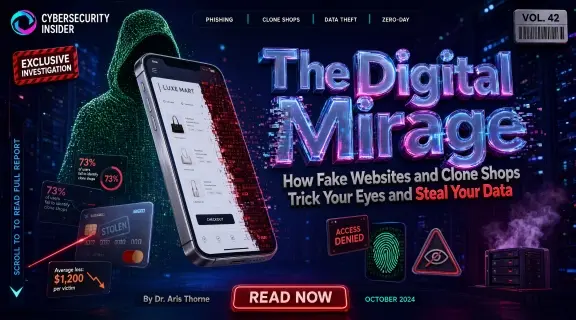
It looks like a high-end e-commerce paradise or a trusted financial portal. The product photos are sleek, the discounts are a jaw-dropping 80% off, and the checkout page glows with official-looking security badges. You enter your credit card number, click "Complete Purchase," and wait for the confirmation. But days turn into weeks, the package never arrives, and your bank account starts bleeding unauthorized charges. Welcome to the digital mirage—the world of cloned and fraudulent websites.
"On the internet, a beautiful storefront takes minutes to build, but a lifetime of financial trust can be shattered in a single click." — The Narrator
The Anatomy of a Digital Mirage: The Rise of Clone Shops
As the narrator monitoring the shifting borders of the web, I have witnessed cybercrime graduate from crude phishing letters to the master-level art of website cloning. Modern fraudsters don't just build random ugly pages; they mirror legitimate global brands, upscale fashion stores, and crypto exchanges down to the very last pixel.
For online shoppers across the United States, United Kingdom, and Europe, these fraudulent portals are pushed aggressively through social media ads on Instagram, TikTok, and Facebook. They lure victims with impossibly low prices during holiday seasons, exploiting the human impulse for a bargain while hiding malicious backend scripts designed to harvest credit card CVV codes and personal identities.
Act I: The Illusion – How Cybercriminals Mimic Trust
The core success of a fake website relies on visual mimicry. Scammers understand that human beings scan web pages in fractions of a second. If they see familiar security seals, smooth loading speeds, and high-resolution product imagery, their guard drops immediately.
Consider the experience of Sarah, a retail enthusiast in London, or Michael, a tech bargain hunter in Toronto. Both stumbled upon flash sales for high-end electronics and designer apparel via social media ads. The layout felt professional, the reviews looked glowing (and entirely fabricated), and the checkout interface accepted their Visa cards without a hitch.
Yet, behind the polished glass of the browser interface, structural indicators exposed the truth: the domain name used a suspicious country-code extension or awkward hyphenation (like brand-name-official-store-2026.com), and the contact page listed no phone number or physical address.
Act II: The Trap – Card Skimming and Identity Theft
Once a user enters their payment details or login credentials on a fraudulent website, the trap snaps shut via automated scripts running silently in the background.
The mechanics behind website fraud typically manifest in two destructive ways:
- The Magecart Skimmer: Hidden JavaScript code intercepts credit card numbers and passwords the exact millisecond the user clicks "Submit," transmitting the sensitive data directly to an offshore command-and-control server.
- The Phantom Goods Scam: The site takes your money, generates a fake tracking number sourced from random courier data, and leaves customer service emails bouncing into an empty void.
Act III: The Turning Point – Exposing Frauds with Instant URL Verification
In every compelling security narrative, the fog clears the moment rigorous analysis is applied. When confronted with an unknown website offering too-good-to-be-true deals, savvy digital citizens don't guess—they rely on infrastructure intelligence.
This is precisely why our platform integrates a robust **Website Scam Checker**. By pasting any suspicious URL into our automated scanning engine, the system instantly cross-references domain creation history, SSL certificate issuers, threat intelligence blacklists, and hosting server reputations to expose fraud before you spend a single cent.
🔍 Found a Suspicious Store? Test the URL Through Our Website Scam Checker Now
Key Indicators: How to Spot a Fake Website Like a Security Pro
To safeguard your finances, banking details, and personal data from clone shops and phishing portals, commit these seven golden rules to memory:
- Absurd Discounts & Pressure Tactics: Flash sales offering 80% to 90% off luxury goods paired with ticking countdown clocks are classic psychological traps designed to short-circuit your logical thinking.
- Suspicious Domain Names: Look closely at the URL structure. Authentic brands use clean, established domains rather than convoluted strings like
shop-brandname-deals-online.shop. - Newly Registered Domains: Fraudulent sites are often created weeks or days prior to launching a scam campaign. Domain age can be checked easily via public WHOIS records.
- Missing or Shady Contact Information: If a webstore lacks a real physical address, customer support phone number, or relies solely on a generic web contact form, steer clear.
- Unusual Payment Gateways: Beware of checkout pages that reject major credit cards and demand payments via cryptocurrency, wire transfers, direct bank deposits, or obscure peer-to-peer apps.
- Broken Links & Poor Copywriting: Many clone shops leave footer links dead, terms of service pages blank, or feature awkward spelling and grammatical errors hidden in plain sight.
- Lack of Independent Reviews: Check outside review aggregators like Trustpilot or Sitejabber rather than trusting the glowing 5-star testimonials plastered directly on the store's homepage.
Comparison Table: Legitimate E-Commerce vs. Fraudulent Clone Sites
| Evaluation Metric | Legitimate Online Store | Fraudulent Clone Site |
|---|---|---|
| Domain Registration Age | Active for years with an established corporate history. | Newly registered within the last few weeks or months. |
| Payment Options | Secure standard gateways (Visa, Mastercard, PayPal, Apple Pay). | Demands crypto, direct wire, or sketchy gift card payments. |
| Customer Support | Real phone numbers, active live chat, and transparent return policies. | Anonymous contact forms, dead emails, or missing support channels. |
| Pricing Structure | Competitive, standard market rates with realistic seasonal discounts. | Unbelievable, uniform deep discounts across every single product line. |
Conclusion: The Final Word from the Narrator
The global marketplace is at your fingertips, but digital storefronts can mask deep traps set by cybercriminals. Never let an appealing discount or polished design bypass your analytical defenses. Before you input your financial credentials, verify the domain.
The narrator leaves you with this final rule: In the digital mirror, beauty can deceive—always let data check the reflection.