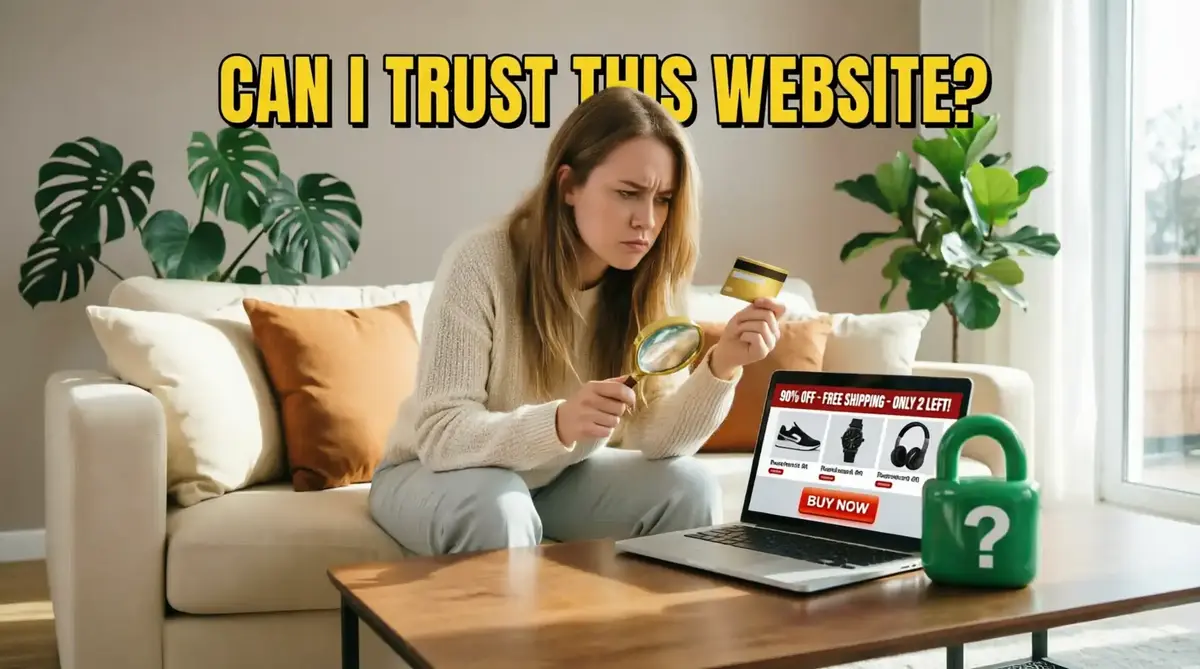
Can I Trust This Website? How to Check a Website Before You Buy
A website can look professional, secure, and completely legitimate—and still leave you with one dangerous question: Can I actually trust it?
The product was exactly what she had been looking for.
The photos were sharp. The website loaded quickly. The price wasn't suspiciously cheap. There was a return policy, a customer-support page, and even a little padlock next to the address bar.
Nothing screamed scam.
And that was precisely what made the decision difficult.
She wasn't trying to prove the website was fake. She was trying to answer a much harder question: Was there enough evidence to trust it?
🔍 The SafeCheck Question
When people ask “Is this website safe?”, they often look for one reassuring signal.
A padlock. A professional design. A familiar logo. A five-star rating.
But trustworthy websites are not proven by one signal. They are proven by evidence that makes sense together.
The Problem With Websites That Look Legit
The easiest fake websites are the ones that look obviously wrong. Broken English. Missing pages. Strange designs. Prices that seem impossible.
Those are easy to walk away from.
The difficult websites are different.
They may have polished branding, attractive product photography, professional layouts, payment options, legal pages, and carefully written descriptions.
In other words, they look like businesses.
And that creates the first rule of our investigation:
A professional-looking website is not proof that a real business is behind it.
Clue #1: How Did You Find This Website?
Before examining the website itself, examine the path that brought you there.
Did you find it through a company you already knew? Or did a social media advertisement introduce you to it?
Did someone send you the link? Did it arrive in an email? Did a search result lead you there? Did you scan a QR code?
The source doesn't automatically make a website trustworthy or fraudulent. But it gives us context.
A website discovered through an unexpected message deserves a different level of scrutiny from a business you've independently searched for and known for years.
“Did I choose this website, or did something choose it for me?”
Clue #2: Can You Identify the Business Behind It?
A website can have a company name. That doesn't necessarily mean the company is real—or that the website belongs to it.
Our next step is to follow the identity chain:
Ask yourself:
- Can I find the business independently?
- Does the company name exist outside this website?
- Do its contact details make sense?
- Can I connect the website to a genuine business presence?
The important word here is independently.
If the only evidence that a company is legitimate comes from the company's own website, you're still looking at a claim—not confirmation.
Clue #3: Don't Let the Website Verify Itself
This is where many online shoppers stop investigating.
They see:
- “Trusted by thousands of customers.”
- “Secure checkout.”
- “Official retailer.”
- “100% satisfaction guaranteed.”
Those statements may be true.
But who is making the claim?
Don't ask only: “What does this website say about itself?”
Ask: “What can I verify somewhere else?”
This simple change in thinking can dramatically improve the way you check a website before buying.
Clue #4: Check the Claims, Not Just the Pages
Fake websites understand that shoppers look for certain pages.
So they create them.
About Us. Contact. Returns. Shipping. Privacy.
The existence of a page doesn't prove the truth of what is written on it.
Instead, look for claims that can be independently tested.
If a website says it is an authorized retailer, can that relationship be confirmed?
If it claims thousands of customers, is there an independent footprint that supports the claim?
If it says a product is shipped from a particular country, does the rest of the business information make sense with that statement?
A claim becomes more valuable when evidence outside the website supports it.
Clue #5: What Happens If Something Goes Wrong?
Here's a question most shoppers don't ask until it's too late:
Imagine the order never arrives.
The product is completely different from the description.
Your payment is taken, but customer support stops responding.
What happens next?
A legitimate business should have a believable path from purchase to support to resolution.
A page that says “Contact Support” is not the same thing as a support system you can actually trust.
Clue #6: Look at the Website as a Whole
This is where the investigation becomes more interesting.
Instead of hunting for one red flag, look for contradictions.
Maybe the company claims to be based in one country, but the contact information points somewhere completely different.
Maybe the business describes itself as established for years, but its online presence tells a very different story.
Maybe the shipping promises, return policy, product availability, and customer-support claims don't fit together.
One unusual detail may have an innocent explanation.
Several unrelated inconsistencies are much harder to explain.
Let SafeCheck Examine the Website
You've looked at the story the website is telling. Now add another layer of evidence by checking the URL with SafeCheck.
CHECK THIS WEBSITE →The Website Trust Test
Before you buy, use this quick investigation framework:
| Evidence | Question |
|---|---|
| Source | How did I arrive at this website? |
| Identity | Can I connect the website to a real business? |
| Claims | Can important claims be verified elsewhere? |
| Support | What happens if my order or payment goes wrong? |
| Consistency | Do the details across the website actually make sense together? |
| Independent Evidence | What evidence exists outside the website? |
💻 What About HTTPS and the Padlock?
This is one of the most common misunderstandings when people ask, “Is this website safe?”
HTTPS is important because it helps protect data while it travels between your browser and the website.
But HTTPS does not automatically prove that the business behind the website is legitimate.
Think of it as a security feature—not a certificate of honesty.
🔎 Before You Click “Buy Now”
If you're still asking “Is this website legitimate?”, don't make the purchase based on appearance alone.
RUN A WEBSITE SCAM CHECK →The Phantom Cart: How Fake Online Stores Build Trust
Some fake stores are difficult to recognize because they are designed to feel normal. The product pages look polished. The checkout looks familiar. The promises sound reassuring.
The Phantom Cart goes deeper into the psychology and mechanics behind fake online stores, helping you understand how scammers create the appearance of a legitimate shopping experience before you ever click “Buy Now.”
EXPLORE THE PHANTOM CART →The Website Passed the Eye Test
Remember the shopper at the beginning?
The website still looked professional.
Nothing about the design suddenly changed.
But the investigation had changed the question.
Instead of asking:
She was asking:
That is a much safer question.
Because scammers can copy a design. They can write convincing policies. They can create polished product pages. They can even manufacture the appearance of popularity.
What becomes harder to fake is a consistent identity supported by evidence outside the website itself.
🛡️ SafeCheck Takeaway
A website doesn't become trustworthy because it looks trustworthy.
Before you buy, pay, create an account, or share personal information, step outside the website and verify the story it is telling you.
Don't just look at the website.
Investigate the business behind it.